

Your AI annotation platform, hosted in France
🔒 VPS onlyThe computer vision annotation suite powered by CVAT, installed and maintained by DINAO. Your images, videos, and datasets stay on our French servers — AI-assisted annotation, on a sovereign infrastructure.
What is CVAT?
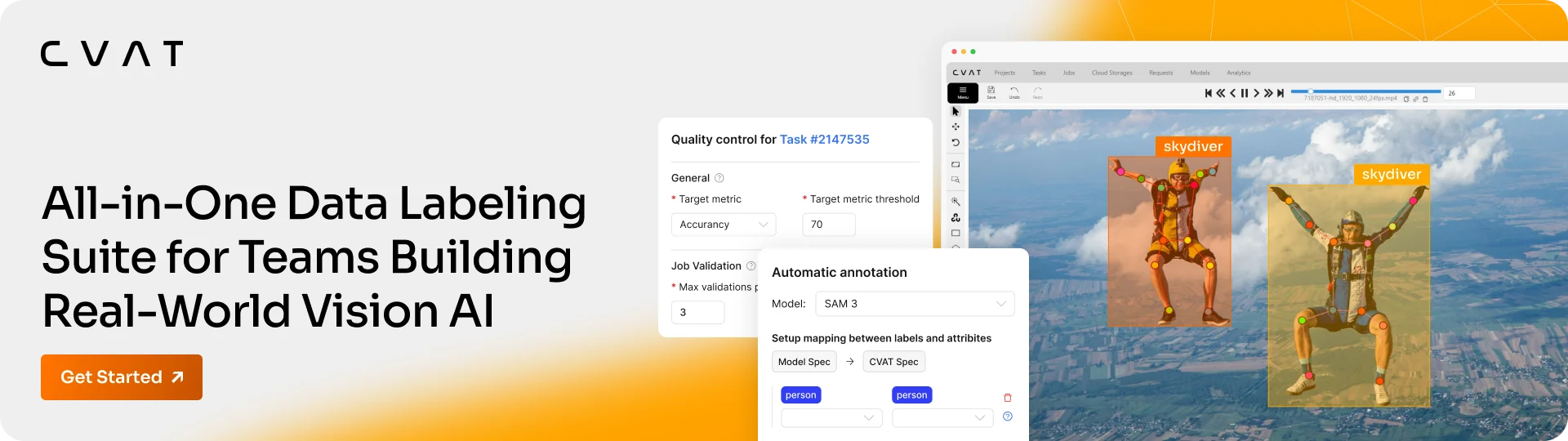
CVAT (Computer Vision Annotation Tool) is an open-source web platform for annotating images, videos, and 3D point clouds, designed to produce training datasets for computer vision. It covers all annotation types — bounding boxes, polygons, polylines, segmentation masks, keypoints/skeletons, cuboids, ellipses, tags — and handles tracking and interpolation for video.
Designed for teams, CVAT provides project and task management, quality control (ground-truth, confusion matrix), analytics, role management (RBAC), as well as AI-assisted annotation via models like SAM/SAM 2, YOLO, or Mask R-CNN. Export covers over 20 standard formats (COCO, YOLO, Pascal VOC…).
Technically, CVAT is built on Django and React, with PostgreSQL and Redis, deployed as a multi-container Docker stack. Auto-annotation relies on Nuclio serverless, and an NVIDIA GPU is recommended for the heaviest models. A REST API, Python SDK, and CLI complete the suite.
Host CVAT at DINAO
No managed container for CVAT: this application is installed on a VPS hosted in France (2 vCPU / 4 Go / 20 Go minimum).
Application available on a VPS
This application requires privileged access to the host machine, which is incompatible with managed shared hosting. It is installed on a VPS (virtual private server) that you administer: DINAO delivers it with Docker and the management panel of your choice, and you install and maintain CVAT yourself. The VPS is not managed by DINAO unless you add the managed-services option when ordering.
Technical reason: montage du socket Docker (contrôle total de l'hôte).
Discover the Docker VPS →Requirements for CVAT: 2 vCPU, 4 Go, 20 Go. Our Docker VPS at €11 excl. VAT per month covers them.
This application uses AI
The container hosts the application, not the AI engine (which requires dedicated GPUs) : inference is handled externally, with your own provider key. Prioritize a sovereign engine — Mistral AI, NumSpot, Scaleway, or OVHcloud AI Endpoints (France, GDPR) ; an international provider (OpenAI, Anthropic…) only if a specific capability requires it. Inference subscriptions are not included in hosting.
Technical details
You might be wondering…
What is CVAT used for?
CVAT is a computer vision annotation suite. You annotate images, videos, and 3D point clouds to produce the training datasets required for AI detection, segmentation, or classification models.
Does AI-assisted annotation run on your servers or an external cloud?
In the self-hosted edition, auto-annotation models (SAM, YOLO…) run locally within your DINAO instance, without calling any external cloud service. Your images never leave the server — see the sovereignty note below.
What export formats are supported?
Over 20 standard formats : COCO, YOLO, Pascal VOC, and many others. You retrieve your datasets in the format expected by your training framework, via the interface, API, or Python SDK.
Do I need a GPU?
Manual annotation works without a GPU. For auto-annotation by large models (especially SAM), an NVIDIA GPU is strongly recommended : it is available as an option (Team AI plan) or dedicated (Production plan).
Can I change plans or export my data?
Yes. You can upgrade or downgrade at any time, and your datasets remain exportable in standard formats — no proprietary lock-in.